





A guide to the 'Tudor Reporting Cycle'...
A guide to the 'Tudor Reporting Cycle'...
Please see the information below on how to get the most from your appointments/ consultations.
To ensure that parents are aware of the attainment and progress of their child, there is a cycle of termly consultation evenings as well as the sharing of a mid-year review and an end of year report.
The consultations and reports are organised as follows:
October Consultation:
Information is shared about how well the child has settled in class as well as the sharing of targets for the year.
February Consultation:
A 'Mid-Year Review' report is shared with the parents as well as information about how the child is progressing towards their learning targets.
July Consultation:
As the academic year draws to a close, the teachers will discuss information about how the child has responded to the learning opportunities during the year. Any key end of year assessment results will also be shared. Furthermore, parents will also be given an end of year report which will highlight the key achievements of their child as well as attainment and progress headlines from the year.
Please look at the 'End of Year Report' example that is attached at the bottom of this report. This is a 'fictitious' example of a child in year 6 who has had a very positive year!
Understanding the Assessment Steps
After using ‘Target Tracker’ software for a number of years to track attainment and progress. We have recently moved to a new ‘Sonar’ tracking system that aims to further enable teachers to efficiently evaluate the attainment and progress of the children. Sonar uses the concept of a whether a child is attaining at an ‘age related level’ for each particular point of their academic journey. This aligns closely to our previous system, which has been praised by Ofsted:
'Teachers are making good use of their handbook for assessment to support the curriculum planning... they know precisely what pupils already understand...they can plan for what they need to learn next.' (Ofsted)
Children over a complete year are expected to maintain their achievement level. As a staff we work hard to maintain and hopefully increase this level of progress. We strongly believe that the more we report the progress of the children to parents using this system, the more the parents will truly understand how their children are responding to the learning opportunities at Tudor Primary.
The different codes are used to show their current level of achievement. A child making expected progress will maintain this level throughout the whole year – but expectations will be different at each assessment point.
- A (Above age-related expectations)
- At (Securely at age-related expectations)
- JA (Just at age-related expectations)
- B (Below age-related expectations but still working within this year group)
- SB (Working below the current year group expectations)
For those children working significantly below, we assess which year group they are currently working within.
The screenshot below shows how at any point, staff members can look at a snapshot of children and analyse focus areas.

There are also multiple different reports that can focus on the progress as well as attainment of children (from whole cohorts down to individuals). This applies across the curriculum and not just the three subjects highlighted above.
Using assessment data to inform our practice
Once assessment data have been analysed. Target children might be identified who are not making the expected levels of progress. The below example report looks at a year 4 class and their reading attainment.
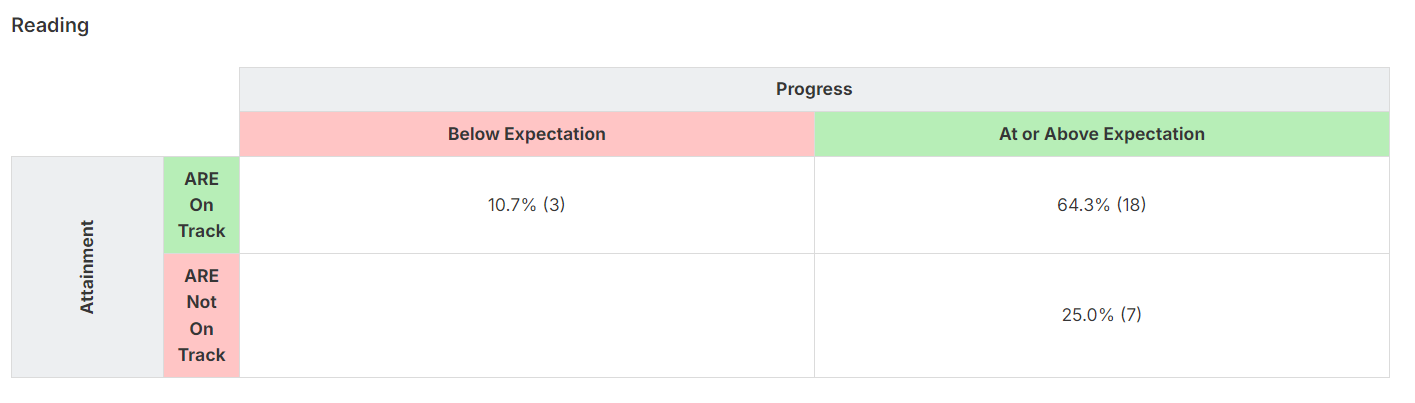
This report highlights three children who are not currently making expected levels of progress (achieving the same outcomes as the were previously), but these children are still age related. For example one of them was ‘securely at’ and now is ‘just at’.
The class teacher would use this information to consider adaptations of provision. We obviously want the children to make AT LEAST expected progress. This report also highlights seven children who are making accelerated progress in this area.
Children will only be assessed at A when they are confidently applying those skills across the curriculum. For example, to be a ‘Above’ in Maths, the child would need to be using maths very competently in subjects such as Science as well as in 'normal' maths learning for that year group.
Developing our ability to report progress...
Teachers are able to 'explain' the information held within the report. We are confident that parents appreciate the detail that our approach to reporting brings.
Partnership with parents is KEY to the success of our young learners' development- academically and socially.
Our approaches to high quality assessment (and reporting) have been a significant factor in our strong academic performance.