





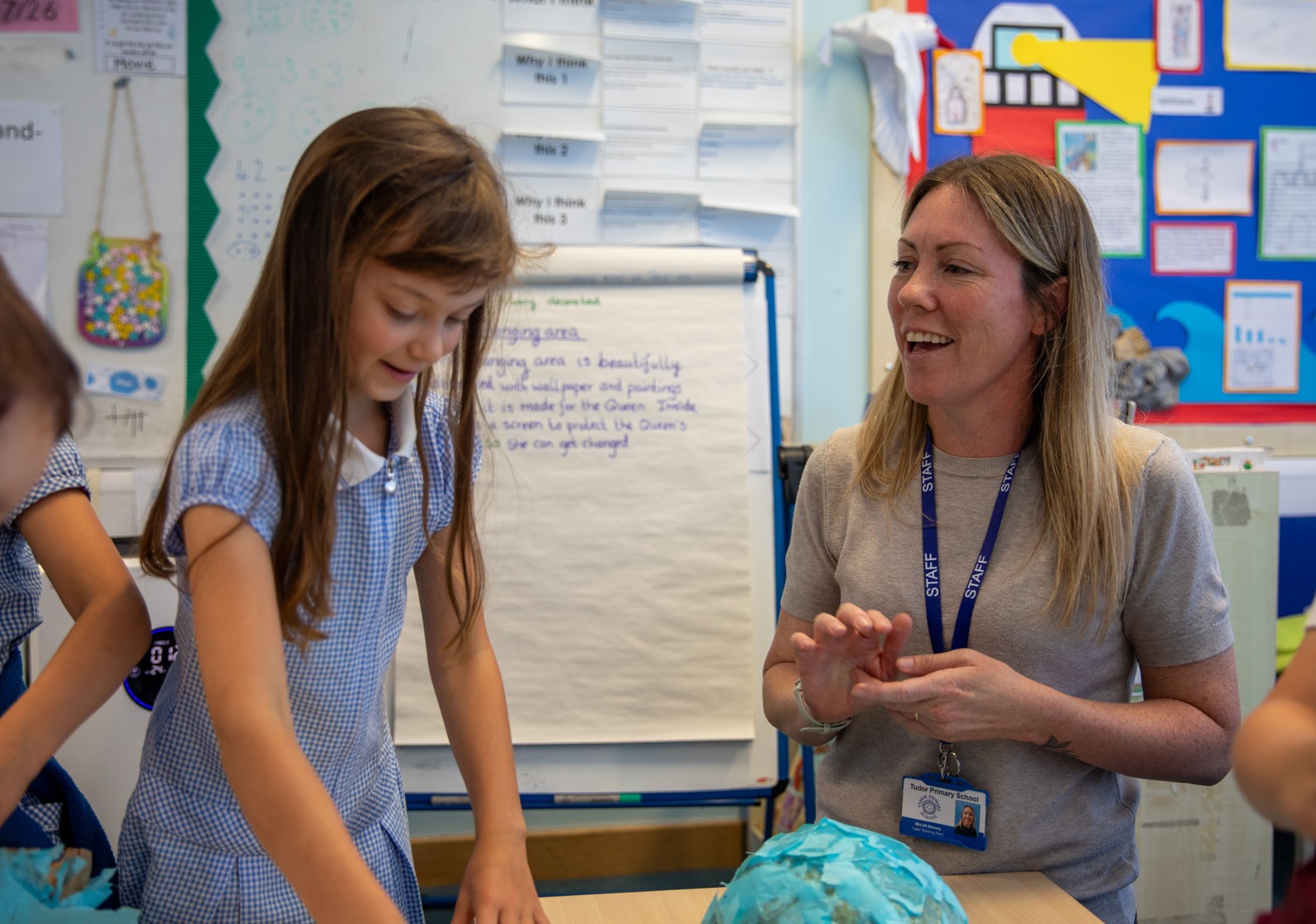
'Strong Foundations'
Our Early Years curriculum that excites and inspires young minds
Together we create a happy and caring community where all our children love to learn and want to achieve.
At Tudor Primary School we aim to provide the highest quality care and education for all our children thereby giving them a strong foundation for their future learning. These foundations begin in the early years. Working alongside parents, we build a curriculum that is led by the children’s interests and is accessible to all. We use the programmes of study as a starting point, and link the themes into these, making cross-curricular links throughout the seven areas of learning, with a higher focus on the prime areas. We provide a child-centred curriculum that is responsive to the needs and next steps of all individuals.
We follow the steps:
We observe
So we plan
As a result, the impact is…
Our Key Principles
As part of our practice we:
- Provide a broad and balanced curriculum, based on the EYFS, across the seven areas of learning, using play as the vehicle for learning.
- Promote equality of opportunity and anti-discriminatory practice. We provide early intervention for those children who require additional support.
- Work in partnership with parents and within the wider community.
- Plan challenging learning experiences, based on the individual child’s interests and programmes of study, that are informed by observations, conversations, interactions and assessments.
- Provide opportunities for children to engage in activities that are adult-initiated and child-initiated, supported and scaffolded by the adult.
- Provide opportunities for children to rehearse and apply what we have taught them.
- Provide a secure and safe learning environment indoors and out.
- Provide an accessible and enabling environment that is relevant to their life and encourages progression of skills.
- Build positive relationships with the children and promote quality interactions with children that move learning forward.
Every child is a unique child who is constantly learning and can be resilient, capable, confident and self-assured. Children are born ready, able and eager to learn.
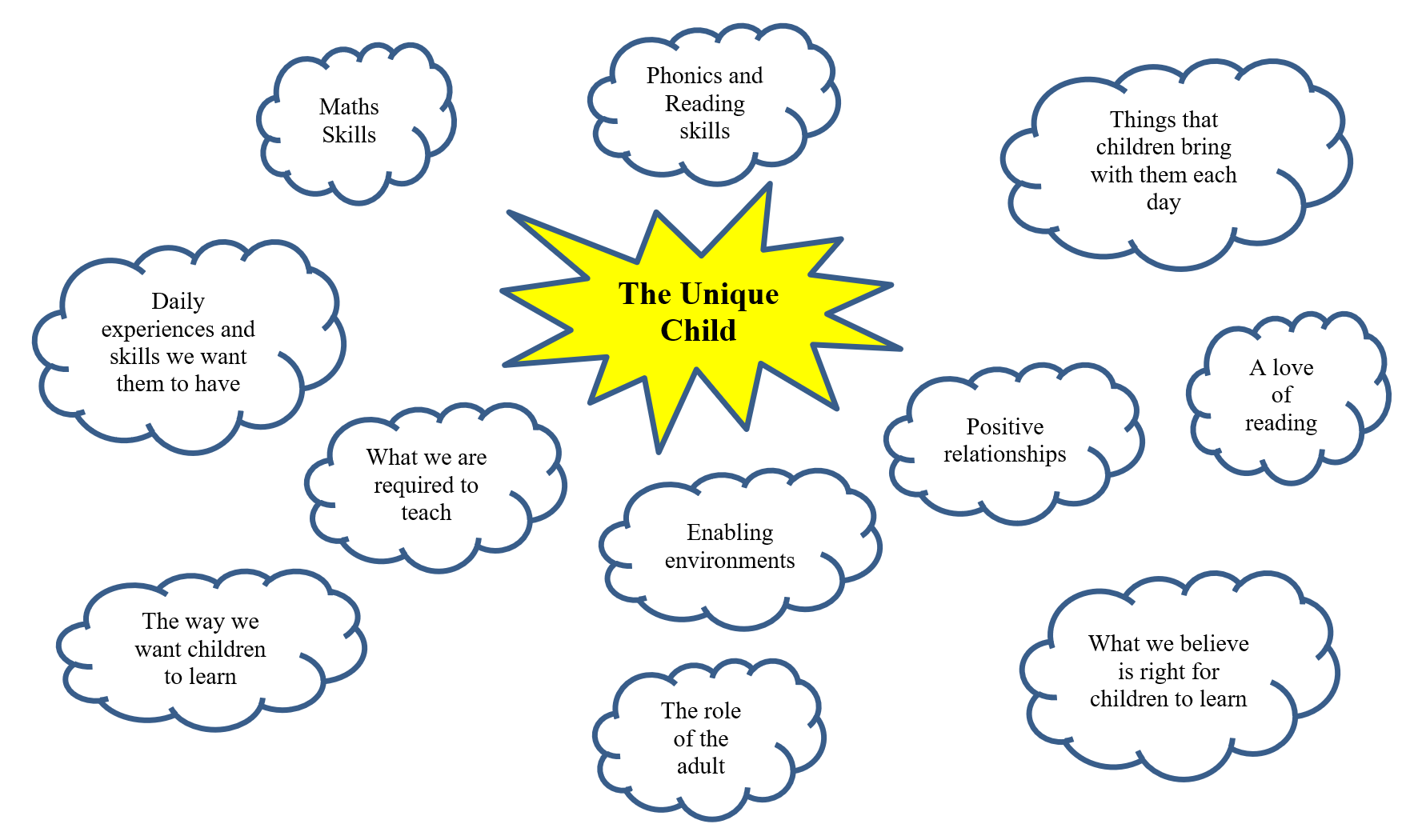
At Tudor school we use the Unique child as our starting point to create an environment of learning opportunities:
Creating those 'strong foundations'
In the table below are the Tudor school values what we strive for our early years children before they transition to key stage one. As children begin at Tudor, we look at what tools and skills they have to start with, we then provide opportunities for them to access on their learning journey, see below, and then analyse at different stages throughout the year the impact of these opportunities on their overall development.
|
Aims |
What we do |
|
To become aspirational in everything they do
|
|
|
To become confident communicators and writers
|
|
|
To become a successful member of the community
|
|
|
To become stimulated by an engaging curriculum that utilises high quality thematic links
|
|
|
To be happy and secure so they can embrace new challenges
|
|
|
To have a love for the natural environment and the world around them
|
|
|
To become fascinated and excited by a range of books
|
|
What does it LOOK like?
When you walk into Tudor Early Years you will see:
- Positive interactions
- Children accessing the environment independently
- Happy and confident children
- Engaging activities
- Sharing, and playing cooperatively and collaboratively
- Listening to one another
- A calm but stimulating environment
- Children embracing new challenges
- Inquisitive conversations
- A sense of belonging
Foundation Stage Curriculum
We plan an exciting and challenging curriculum based on our observation of children’s needs, interests, and stages of development across the seven areas of learning to enable the children to achieve and exceed the early learning goals.
All the seven areas of learning and development are important and inter-connected.
Three areas are particularly crucial for igniting children's curiosity and enthusiasm for learning, and for building their capacity to learn, form relationships and thrive.
These three areas are the prime areas:
Communication and Language
Physical Development
Personal, Social and Emotional Development
Children are also supported through the four specific areas, through which the three prime areas are strengthened and applied.
The specific areas are:
Literacy
Mathematics
Understanding the World
Expressive Arts and Design
Children are provided with a range of rich, meaningful first-hand experiences in which children explore, think creatively and are active. We aim to develop and foster positive attitudes towards learning, confidence, communication and physical development.
As a team, planning begins with the children’s interests. We then link it to the programmes of study and provide experiences in all seven areas of learning, also looking at how we can build on skills that the children already have.
Practitioners working with the youngest children in Nursery will focus strongly on the three prime areas, which are the basis for successful learning in the other four specific areas. The three prime areas reflect the key skills and capacities all children need to develop and learn effectively, and become ready for school. The balance will shift towards a more equal focus on all areas of learning as the children move through the Early Years and grow in confidence and ability within the three prime areas.
Children have whole group and small group times which increase as they progress through the EYFS with times for a daily phonics session, teaching aspects of Mathematics and Literacy, including shared reading and writing.
Characteristics of effective learning
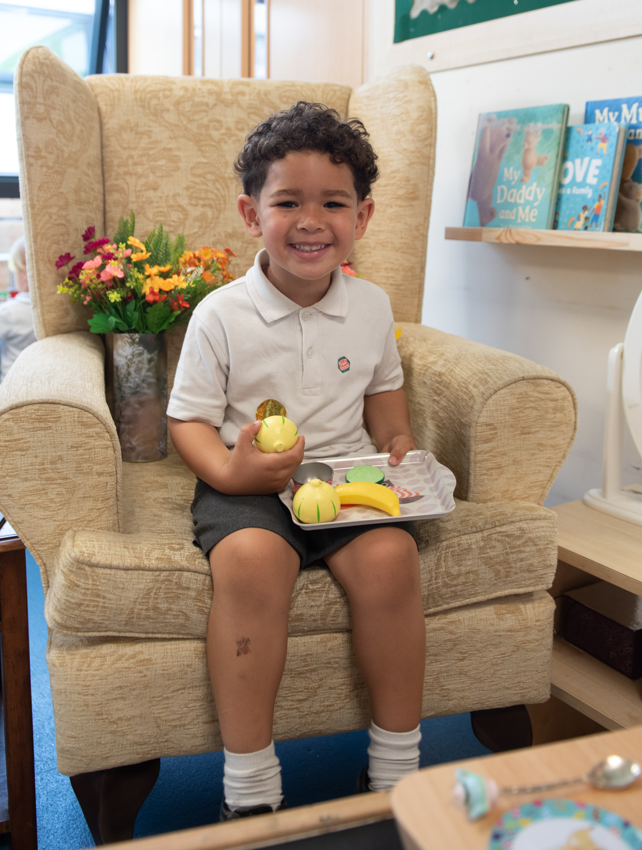
The EYFS also includes the characteristics of effective learning. All early years practitioners plan activities, teach and challenge children based on these characteristics. They highlight the importance of children’s attitude to learning and their ability to play, explore and think critically about the world around them. The three characteristics are;
- playing and exploring - children investigate and experience things, and ‘have a go’
- active learning - children concentrate and keep on trying if they encounter difficulties, and enjoy achievements
- creating and thinking critically - children have and develop their own ideas, make links between ideas, and develop strategies for doing things
Learning through play
The curriculum is delivered using a play-based approach as outlined by the EYFS. ‘Each area of learning and development must be implemented through planned, purposeful play and through a mix of adult-led and child-initiated activities.’
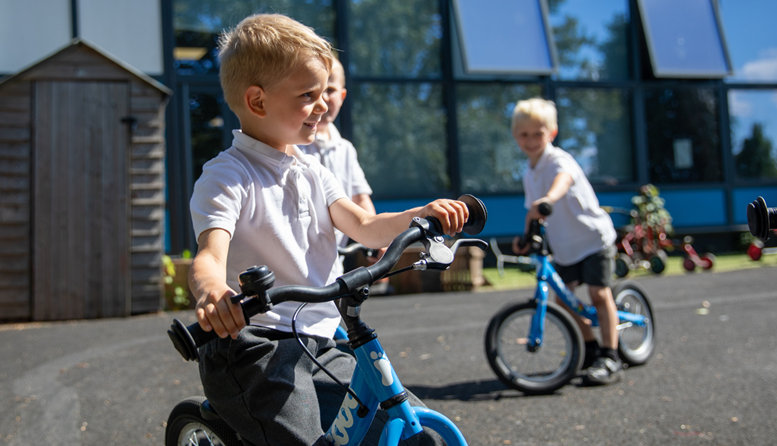
Learning through play underpins our approach to teaching and learning in the Foundation Stage. Young children learn best from activities and first-hand experiences that interest and inspire them to learn. Therefore, we provide children with stimulating, active play experiences in which they can explore and develop their learning to help them make sense of the world around them. We encourage children to free-flow between the indoors and outdoors to ensure the children are provided with a wide range of stimulating experiences. Children have opportunities through their play to think creatively and critically alongside other children. They are able to practise skills, build upon and revisit prior learning and experiences at their own level and pace. Play gives our children the opportunity to pursue their own interests, inspires those around them and consolidates their understanding and skills. The children learn to adapt, negotiate, communicate, discuss, investigate and ask questions.
We plan a balance between children having time and space to engage in their own child-initiated activities and those that are planned by the adults. During children’s learning through play opportunities, early years practitioners take an active role in child-initiated play through observing, modelling, facilitating, teaching and extending play, skills and language. In planning and guiding children's activities, we reflect as practitioners on the different ways that children learn in our setting and adapt when necessary.
Assessment
Throughout nursery and reception children’s knowledge, understanding, skills and achievements are assessed and tracked. We use the developmental stages set out in the document ‘Development Matters in the Early Years Foundation Stage (EYFS)’ as a set of stepping stones to guide us through the skills we will teach the children. In reception, we use a range of assessment tools to identify gaps in learning, particularly in Communication and Language such as the Welcom screening, and the NELI assessment tool. The baselines collated, work alongside the Reception Baseline Assessment to identify next steps in learning. Daily assessments are made of target children, exploring skill progression and gaps in the prime areas that we will plan into our curriculum.
As part of our daily practice, our assessments are gathered from a range of sources; talking and playing with the children, observations of the children in play and learn, and adult led activities. We identify and note areas of interest that children want to explore further, and feed these into our weekly planning. We highlight any ‘Wow moments’ of significant progress/ learning and add these to tapestry. The whiteboard system helps to identify any children that are not making progress and therefore plan targeted support to bridge the gaps. We also make assessments through discussions with parents and carers. We record observations on an online program called Tapestry. An online learning journey is created for each child which builds a picture of the children’s strengths and achievements and enables us to plan for children’s next steps in learning. This allows parents to contribute to the observations and assessments made by staff, and of their own observations from home.
In the Autumn and Spring terms, parents are invited to attend a parent’s evening where they can discuss their child’s progress with their child’s teacher. In the Spring term, parents are given a ‘mid-year report’ that provides key information on the learning opportunities that are provided. Next steps are also shared and this supports the parents with how to help the child progress academically and socially.
Within the final term of Reception class, we assess children’s knowledge, skills and understanding. The children’s progress will continue to be tracked throughout the foundation stage and will be assessed against the ELG’s at the end of reception. These assessments will be used to establish an end of foundation stage achievement and learning profile for each child based on the Early Years Foundation Stage Profile. The parents will be provided with a final report based on their child's development against each of the Early Learning Goals and the characteristics of their learning. Parents/carers are then given a further consultation to discuss these judgements with the Reception class teacher, if necessary in preparation for Year 1.
Skills-based Approach
This is the third year of our skills-based curriculum. We have created a document that outlines progression of skills from the start of nursery to the end of reception. There are twelve areas of focus, which intertwine with each other in both the indoor and outdoor areas. The document ensures we are modelling and teaching children key skills in their play and modelling key vocabulary linked to the skills. Within an area of the learning there are key behaviours we are teaching the children so their learning and experiences are constantly developing and growing.
See below for an example:

Safety
Children’s safety and welfare is paramount. We create a safe and secure environment and provide a curriculum which teaches children how to be safe, make choices and assess risks. We have stringent policies, procedures and documents in place to ensure children’s safety.
We promote the good health of the children in our care in numerous ways, including the provision of nutritious food, following set procedures when children become ill or have an accident.
Please see our separate policies and procedures on Health and Safety and Child Protection.
Inclusion
At Tudor Primary School, we are committed to providing an inclusive and welcoming Early Years environment in which every child is valued, respected and supported as a unique individual. We celebrate diversity and recognise and value children’s different cultures, ethnicities, religions, languages, family backgrounds, abilities, needs and experiences.
We believe that every child has the right to access high-quality Early Years education and to participate fully in the life of the school. We aim to identify and remove barriers to learning to ensure that all children have the opportunity to develop their skills, confidence, independence and sense of belonging.
Our curriculum and learning environment are carefully planned and adapted to meet the individual needs, interests and developmental stages of each child. The Early Years team use their knowledge of each child to provide appropriate levels of challenge, support and scaffolding, making reasonable adjustments where necessary to enable children to access learning and participate alongside their peers.
We strongly believe that early identification of children with additional needs is crucial in enabling us to give the child the support that they need to make progress. Where concerns arise, we will work closely with parents and carers to develop a shared understanding of the child’s strengths, needs and next steps. Where appropriate, we will work with the school’s Special Educational Needs Coordinator (SENDCo), external professionals and other agencies to ensure that children receive appropriate support as early as possible.
We monitor children’s learning and development carefully so that support and provision can be reviewed and adapted as children’s needs change.
Early Years Pupil Premium
We will identify children who may be eligible for Early Years Pupil Premium (EYPP) and ensure that parents and carers are informed about their child’s potential entitlement and how to apply. Where EYPP funding is received, it will be used to support the individual child’s learning, development, wellbeing and participation.
We will regularly monitor and review each child’s progress, adapting support and provision in response to their developing needs. This will help to ensure that the support provided has a positive impact on the child’s outcomes and promotes their access to learning.
Parents as Partners
We strive to create and maintain partnership with parents and carers as we recognise that together, we can have a significant impact on a child’s learning. We welcome and actively encourage parents to participate confidently in their child’s education and care in numerous ways. Blogs are shared with parents to ensure they are more aware of what is happening in school and how to support children at home.
Working with other services and organisations is integral to our practice in order to meet the needs of our children. At times we may need to share information with other professionals to provide the best support possible.
We draw on our links with the community to enrich children’s experiences by inviting members of the community/ parents into our setting.
Transition
Transitions are carefully planned for and time given to ensure continuity of learning. At any transition, we acknowledge the child’s needs and establish effective partnerships with those involved with the child and other settings, including nurseries and child-minders. Children attend introductory sessions to Nursery and Reception to develop familiarity with the setting and practitioners. They receive an information pack containing photos of the setting and all staff, and complete a ‘Unique Child’ booklet. We now host two open stay and play sessions for parents and children to attend to visit their new setting, meet the staff and become familiar with their new learning environment. We hold an evening welcome meeting for parents/ carers to meet the staff, ask any questions and learn about expectations for starting Tudor school. We also provide opportunities for singular families to come to visit the setting after school when it is calm and quiet so the child can adjust to it slowly. Both nursery and reception arrange transition visits with nurseries to meet the children, and also make phone calls to all previous settings for a phone call handover.
In the final term in Reception, the Year 1 teaching team meet with the Early Years staff and discuss each child's development against the Early Learning Goals in order to support a smooth transition to Year 1. This discussion helps the Year 1 teacher to plan an effective, responsive and appropriate curriculum that will meet the needs of all children. The Year 1 team also spend time in the reception class at different points of the day to familiarise themselves with the children. The reception children spend time in their new class, and start to attend assemblies and playtimes in Summer 2. Children begin Tudor with a wealth of information from the new starter pack, provided at the beginning of the year which sets out the expectations we have when attending Tudor school.
Please refer to our Transition policy for further guidance.
Oracy
This year our whole school focus is oracy. As an Early Years team, we have made this a high priority and have been having weekly training sessions on it led by Jordan Pike. Oracy is a fundamental part of learning and development in the EYFS, as it supports children to communicate their thoughts, feelings, ideas and needs effectively. Through meaningful conversations, storytelling, songs, rhymes and interactions with adults and other children, children develop their vocabulary, listening skills and confidence in expressing themselves. Strong oracy skills provide an important foundation for later reading and writing, as children who have a broad vocabulary and understand how language is used are better prepared to make sense of written language. Oracy also supports children’s social and emotional development by helping them to build relationships, negotiate, take turns, solve problems and understand different perspectives. Providing children with rich opportunities to talk and listen therefore plays a crucial role in supporting their overall development and preparing them for successful learning throughout their education.

We have a weekly focus for staff to be mindful of in their interactions with the children, such as:
- commentary over questioning
- valuing wait time
- promoting social communication
- how to support quiet children
- recasting and expanding language
- providing a language rich environment
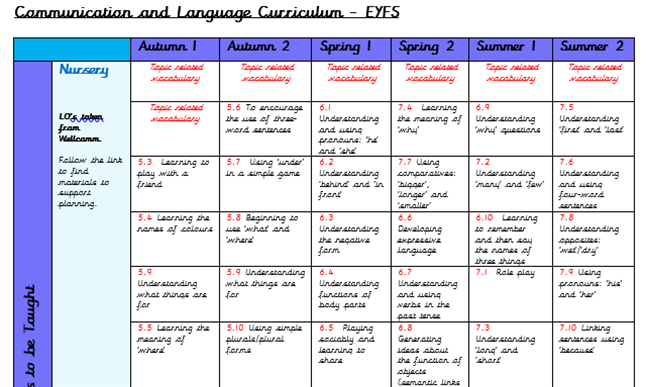
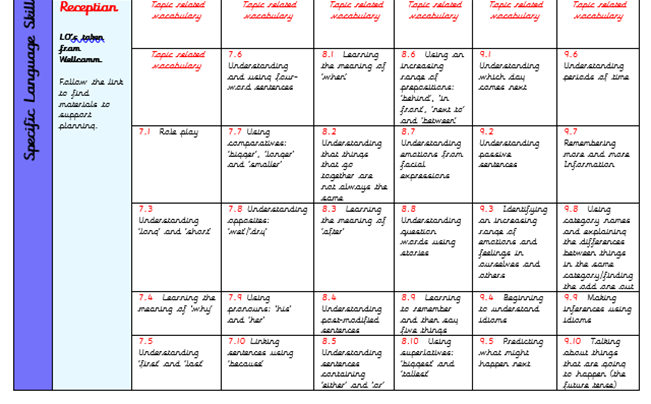
In our communication and language curriculum, we have explicit teaching on key vocabulary, wellcomm and articulation interventions, NELI intervention, and word Wednesday.
Please see the focus of our curriculum below:
As a team we have created subject specific vocabulary to be taught explicitly for each area of learning. This vocabulary is displayed on our commentary sheets in all areas around our classroom. Commentary sheets are a tool for adults to be able to prompt, scaffold and enhance children's oracy skills in their play.

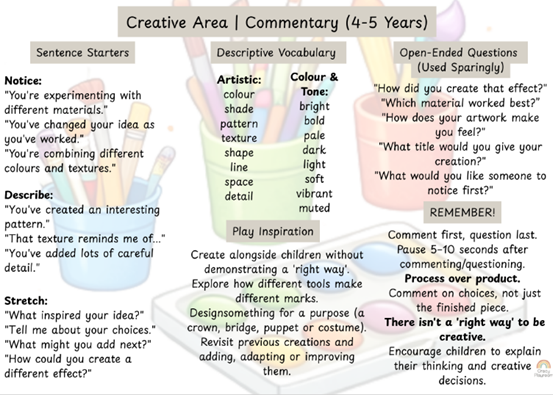
As you can see, the key vocabulary and sentence stems are differentiated across our Nursery and Reception classrooms, and link to our skills based curriculum.
Early Years Foundation Stage at Tudor!
